Program Configuration Snapshot
When a service is created, the relevant program line items are snapshotted so later program edits do not rewrite the active service.

SERVICES
A SecureCare service carries the program’s configured billing and workflow into a specific customer interaction. Services can be created from appointments, case planning, or scheduled-service automation and stay connected to documentation, funding, inventory, and reporting.
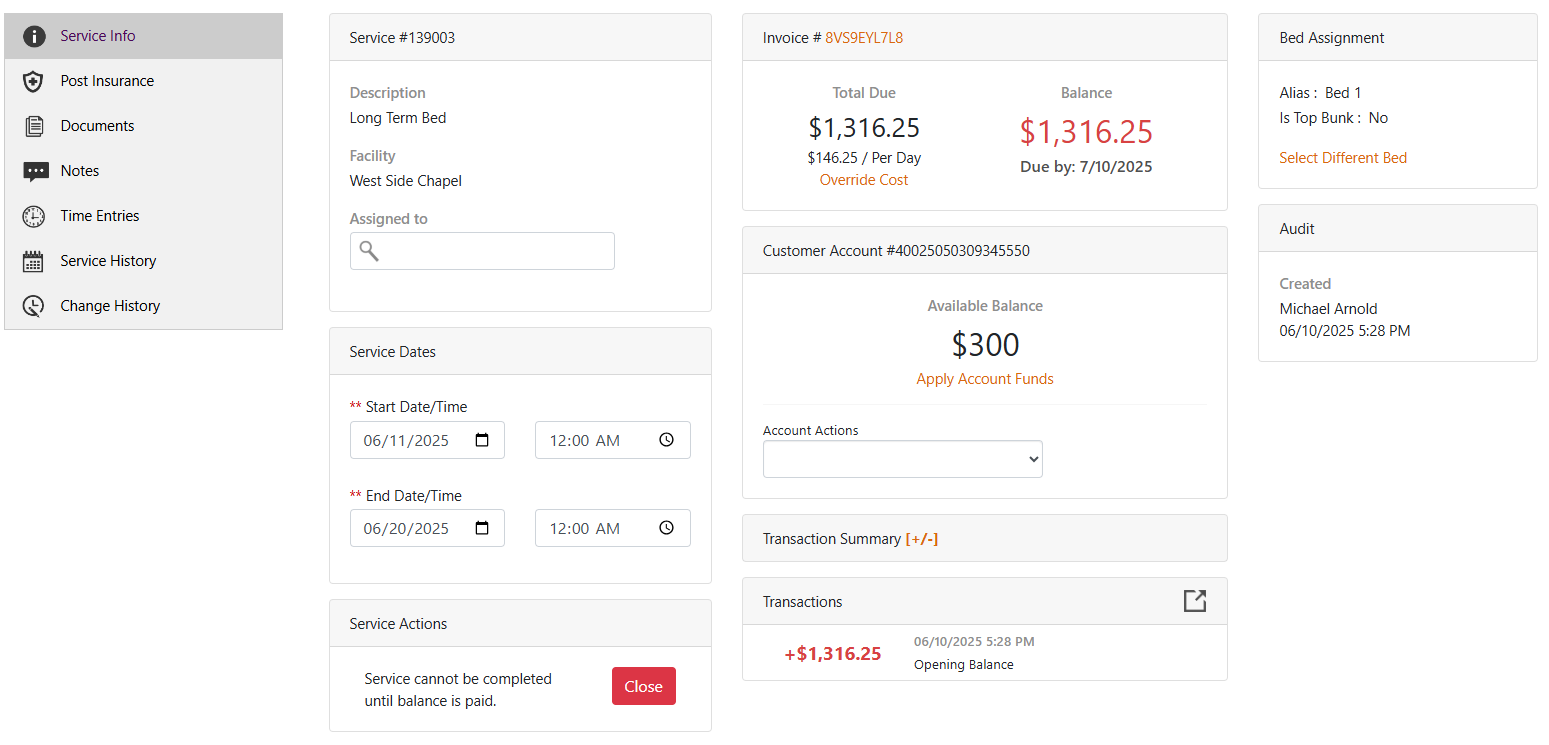
When a service is created, the relevant program line items are snapshotted so later program edits do not rewrite the active service.
Authorized staff can create services from appointments, cases, or scheduled-service workflows.
Service actions respect the create, submit, approve, complete, close, reopen, and related permissions configured for staff.
The service uses program billing rules and can participate in customer, donation, insurance, and other supported funding workflows.
Program-linked inventory can decrement on completion and service activity can feed reporting.
HOW IT WORKS
Programs define the reusable rules; the service is the instance delivered to the customer. SecureCare preserves that distinction so the organization can change tomorrow’s program configuration without silently rewriting yesterday’s service.
Start from the appropriate program, appointment, case, or scheduled-service context.
Carry the configured line items, billing model, approval, and other relevant settings into the service.
Record the work, notes, supporting documents, and service details.
Apply the supported billing, funding, insurance, payment, and linked-inventory behavior.
Preserve the service history and make the activity available to reporting.
A CLOSER LOOK
Programs define the reusable rules; the service is the instance delivered to the customer. SecureCare preserves that distinction so the organization can change tomorrow’s program configuration without silently rewriting yesterday’s service.
KEY CAPABILITIES
Preserve the applicable program configuration on the service.
Create the related billable service from an appointment when authorized.
Keep services connected to the case and customer journey.
Allow Scheduled Services to create future service instances.
Control service actions through staff permissions.
Use the billing model configured by the program.
Participate in supported customer and organizational funding workflows.
Use program insurance configuration where applicable.
Apply linked inventory movement at service completion.
Keep service-specific records attached to the service.
Carry service activity into program and organization reporting.
CONNECTED ACROSS SECURECARE
Turn program rules into accountable, traceable service delivery.
PEOPLE. PURPOSE. POSSIBILITIES.