Efficient Scheduling
See appointments for selected staff and facilities in a day-grid scheduler.

APPOINTMENTS
SecureCare brings staff scheduling, customer self-booking, program rules, reminders, calendar synchronization, and the service that follows into one connected appointment workflow.
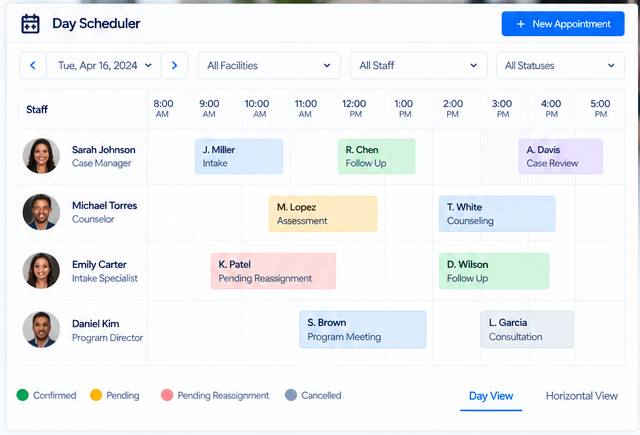
See appointments for selected staff and facilities in a day-grid scheduler.
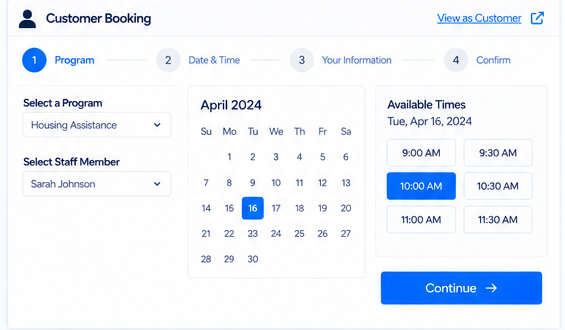
Eligible customers can book through the Patron portal using real availability and program rules.
Email and SMS reminders can include one-tap confirmation without requiring login.
Appointment changes stay synchronized with connected calendars.
Reduce scheduling friction while keeping appointments connected to the work that follows.
HOW IT WORKS
A connected scheduling process keeps staff, customers, communications, and calendars aligned.
Customer books online or staff schedules the appointment.
Availability and program cool-down rules are checked.
Consent-aware email and SMS reminders are sent under program settings.
The customer can confirm through a one-tap link without logging in.
New, rescheduled, and cancelled appointments update connected calendars.
MORE THAN A CALENDAR. A STRONGER MISSION.
SecureCare aligns appointment availability with staff, facilities, program rules, communication preferences, and the operational work surrounding the appointment.
KEY CAPABILITIES
View selected staff and facilities together in a day-grid, with persisted scheduler selections.
Switch orientation when a horizontal appointment view better fits the workflow.
Patron-linked customers can book eligible appointments against real staff availability.
Booking respects program settings, including configured cool-down periods.
Program-level reminder settings support email, SMS, and one-tap confirmation.
Connected calendar events are created, updated, or cancelled as the SecureCare appointment changes.
Appointment times are interpreted in the facility's time zone across scheduling and communications.
Programs can associate signature documents with the appointment workflow.
Authorized staff can create the related billable service directly from the appointment.
CONNECTED ACROSS SECURECARE
Appointments connect customers, staff, facilities, programs, reminders, signature documents, and billable services.
PEOPLE. PURPOSE. POSSIBILITIES.
Reduce barriers, keep everyone aligned, and turn scheduled time into connected service.