Built for Trust
Platform escrow, hold management, and explicit financial controls protect the integrity of the record.

ACCOUNTING & PAYMENTS
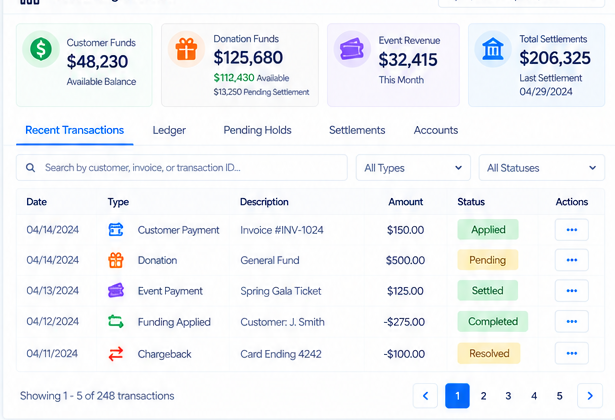
SecureCare provides a true double-entry ledger, secure payment processing, and a complete transaction record so organizations can manage customer funds, donations, revenue, settlements, and service funding with confidence.
Platform escrow, hold management, and explicit financial controls protect the integrity of the record.
Double-entry accounting and an immutable transaction log preserve an auditable history.
Apply eligible customer, facility donation, and organization donation funds to services under permission and program rules.
Payment processing is priced at cost, with fees disclosed and recorded with the related transaction.
Donations, grants, recurring payments, settlements, and promo codes connect to the same accounting layer.
DIFFERENT SOURCES. DIFFERENT PATHWAYS.
SecureCare does not force every payment through one simplified lifecycle. Customer-held funds, donations, event revenue, and service funding each retain the accounting treatment appropriate to that transaction.
Customer funds are held custodially. The customer balance updates at deposit time and can be used for eligible in-platform service funding under the ledger's application rules.
Donations do not become spendable donation balance when first received. They remain subject to the donation hold and settlement process before becoming available for eligible service funding.
Event payments clear through their payment lifecycle and become event revenue. They are not presented as donation funds or as customer-held service balances.
Eligible customer balances, facility donation funds, and organization donation funds can be combined to fund a customer's program service when both staff permission and program rules allow it.
MORE THAN PAYMENTS. A STRONGER FINANCIAL FOUNDATION.
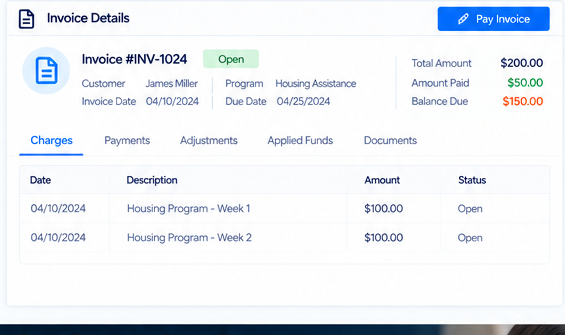
From public invoice payments to multi-source service funding, SecureCare keeps financial activity traceable without pretending that every transaction behaves the same way.
KEY CAPABILITIES
Payments, refunds, transfers, fund applications, insurance postings, and chargebacks are recorded through balanced accounting entries.
Committed transactions are not silently rewritten; corrections are made through new recorded entries.
Processor-held funds, donation holds, and settlement activity remain visible within the financial lifecycle.
Revenue, Donations, and Operating sub-accounts keep different classes of funds visible rather than mingled.
Distinct transaction types preserve the financial story instead of flattening everything into a generic payment.
Customers can locate, view, print, and pay eligible invoices without creating an account.
CONNECTED ACROSS SECURECARE
Donations deposit through it. Grant drawdowns post against it. Recurring payments charge through it. Settlements sweep cleared funds from it. Promo codes apply discounts within it.
REAL PEOPLE. REAL CHANGE.
Manage money with integrity, preserve the audit trail, and keep resources connected to the work they support.