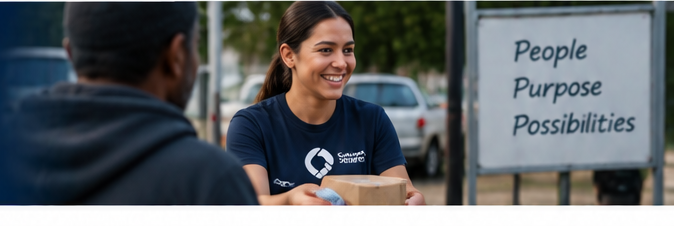
Community Service
The work that doesn't fit a customer record.
A lot of mission-driven work happens outside the customer file. The Saturday lunch run hands meals to people who don't have intake forms. The cold-weather drive distributes blankets to whoever shows up at the warming station. The community event gives out hygiene kits to anyone who walks past the table. Before SecureCare's Community Service module, this work either lived in a separate spreadsheet or got force-fit into the customer/case framework that wasn't built for it. Now it has its own home: community services describe the recurring outreach (Saturday Outreach Lunch, First-Friday Cold Weather Drive), sessions are the individual occurrences, and line items capture exactly what was dispensed. The inventory you stocked, the bundles you assembled, the audit trail you need for the grant report — all of it works the same way it works for customer-attached services.
-
Customer-Less by Design
The customer file works beautifully for the people you intake, case-manage, and serve through structured programs. It doesn't work for the work where there's no customer to attach to. Community Service is the dedicated home for that work — the meals, the supplies, the connection points where you don't ask for someone's name. The records that get created here are first-class operational data with their own audit trail and reports, not workarounds layered over a customer model that wasn't built for them.
-
Two Layers — the Service and Its Sessions
A community service is the recurring outreach itself: a name (Saturday Outreach Lunch), a description, a typical time of day, a recurrence pattern (one-time, daily, weekly, monthly) for display and reporting. A session is one specific occurrence of that service: Session 1 on April 8, Session 2 on April 15, each with its own date, notes, and line items. The service holds the pattern; the sessions hold the work. Multiple sessions run under the same parent service over time, building up a record of every outreach run.
-
Three Kinds of Line Items, One Session
Each session captures what was actually dispensed through line items, and each line can be one of three things. An inventory item — a specific SKU drawn from the facility's stock, with description and costs auto-pulled from the item record. A bundle — a named grouping like the Munn Park PB&J Lunch Bag, with a quantity (10 bundles, 25 bundles); the components decrement together. A free-form line — anything that doesn't live in inventory: services rendered, third-party items distributed, ad-hoc dispenses, with staff-entered description and costs. Mix all three on a single session as the work demands.
-
Plan, Then Commit
Most operational systems treat dispense as immediate — you take stock out, the books update. Community Service uses a two-phase model that fits how outreach actually gets planned. A new session opens in Planned status: the line items reserve their inventory (decrementing Available, not On Hand), so other concurrent work can't claim the same supplies. When the outreach actually happens, staff complete the session — reservations commit and stock leaves On Hand for real. If the outreach gets cancelled before it happens, staff cancel the session and the reservations release back to On Hand. The intent is captured separately from the realization, with the audit trail to match.
-
Insufficient-Stock Validation, Up Front
Saving a session that needs 50 sandwiches when only 30 are available doesn't silently fail or quietly oversubscribe inventory. The save is rejected with a specific message: "Insufficient inventory: 'PB&J Sandwich': need 50, available 30 (on hand 50, reserved 20)." Staff see exactly what's short, what's already reserved elsewhere, and what's actually free. No surprises on the day of the outreach when the kitchen discovers the bread is gone.
-
Distribution Templates — Pre-Built Outreach
The Wednesday lunch run uses the same bundles every week. The cold-weather drive sends out the same hygiene kits every distribution. Distribution Templates capture the standard outreach plan: a named template that points at a bundle (or a custom mix of items) with a quantity. When it's time to record an outreach run, applying the template handles the dispense in one step. Each template tracks how many times it's been used and when it last ran, so you can see at a glance which outreach plans are active and which have gone dormant.
-
Recurrence Patterns for Display and Reporting
Each community service describes its cadence: one-time on a specific date, daily for a stretch, weekly on a chosen day, monthly on a particular day-of-month, with intervals (every 2 weeks, every 3 months) for non-standard patterns. The platform builds a human-readable schedule summary — "Weekly on Saturday · 10:00 AM – 2:00 PM · May 1, 2026 – Aug 1, 2026" — for calendars, dashboards, and reports. The next-session-date helper suggests when the next session should be based on the pattern and the last session held; staff confirm and create the session manually.
-
Per-Movement Cost Capture
When stock moves — reserved, committed, returned, adjusted — the platform captures the wholesale cost and retail price at the moment of the movement, not just the item's current pricing. If the wholesale cost of a sandwich changes mid-year, sessions before the change still report the old cost; sessions after report the new. Grant reports and historical analyses see the actual numbers from the actual time period, not what those items happen to cost today.
-
Connected to Inventory, Facilities, Reports, and Grants
Community Service runs on top of Inventory — bundles assembled there are the bundles dispensed here, with the same reservation system that customer-attached services use. Each community service belongs to a Facility; multi-facility organizations can run separate outreach programs at each site. Total cost data flows into Reports for impact and outcome reporting; staff time logged against community service work flows into Grants as Personnel or Fringe expenditure, the same way it does for case-attached work. Outreach is part of the platform, not separate from it.